Analyzing a Cycling Crash: Insights from Apple Health Data
After a cycling accident left him with memory loss, Adam Engst turned to Apple Health data to uncover the circumstances surrounding his crash. His analysis of heart rate and activity data revealed insights that could help medical professionals understand whether he fainted or simply fell due to an external factor.
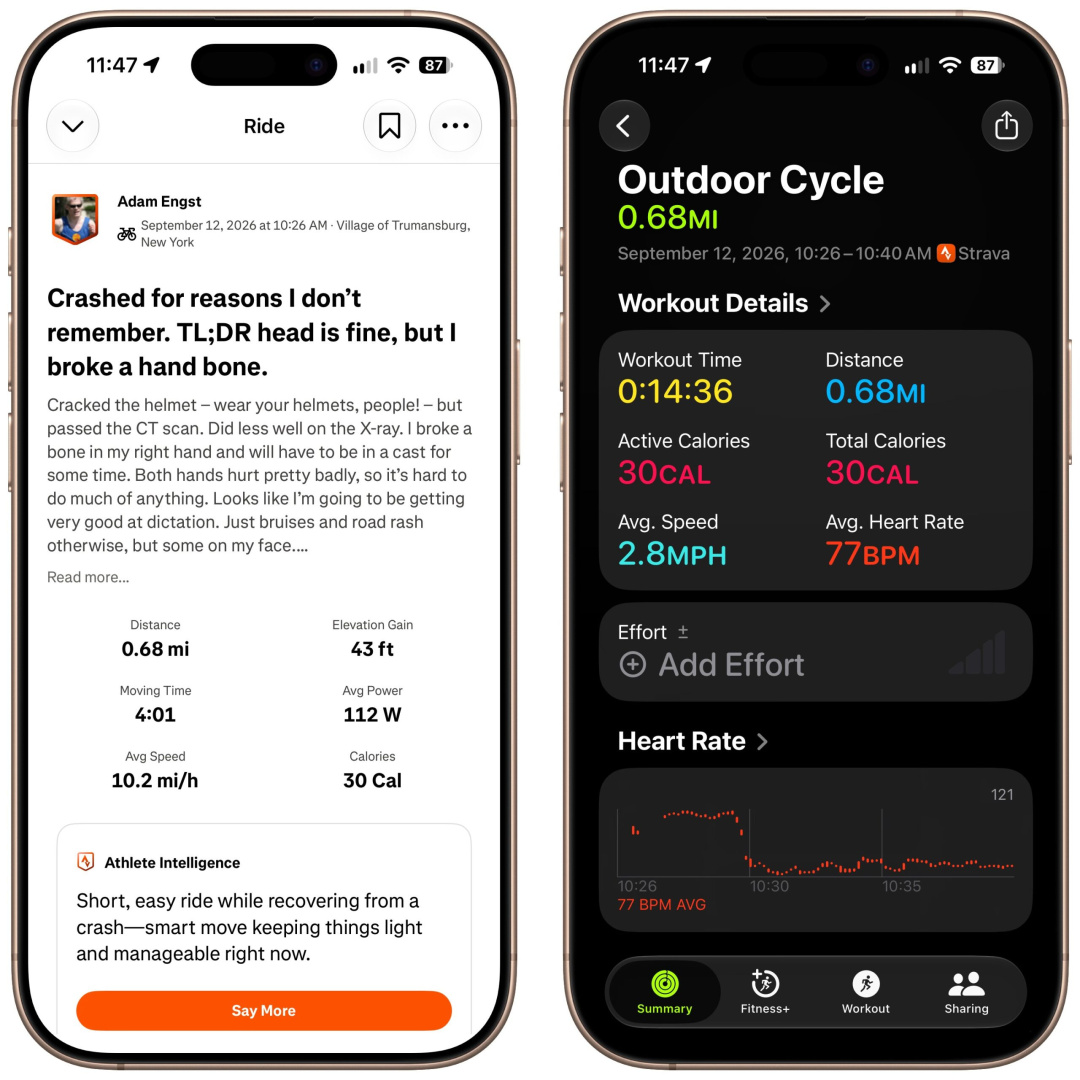
On September 12, 2026, Adam Engst experienced a cycling crash shortly after beginning a planned 45-mile ride on his ElliptiGO elliptical bicycle. He recalls the start of the ride and making two turns before suddenly finding himself on the ground, bleeding from his nose, with several bystanders assisting him. Striking the left side of his head, Engst sustained a cracked helmet, strained muscles in his left hand, a fractured scaphoid bone in his right wrist, and various abrasions on his body, including his face. Despite his injuries, he had no memory of the fall, raising questions about the cause of the accident.
In the emergency room, a CT scan ruled out serious brain injuries, but the memory loss prompted further investigation. Engst's primary care physician referred him to specialists in neurology and cardiology to explore the possibility of fainting or a seizure leading to the crash. He reflected on a previous fainting episode while doing via ferrata in Whistler, British Columbia, and wondered if a similar incident could have caused his recent fall.
Engst noted that the relatively small size of his skin injuries suggested he may not have fallen at high speed, as larger scrapes are typical in more severe accidents. He turned to his Apple Health data for clarity, examining his Strava workout logs and heart rate data recorded by his Apple Watch. The data indicated that he began his ride at 10:26 AM and crashed at approximately 10:30 AM, coinciding with a significant drop in heart rate from around 120 bpm to about 60 bpm, which could indicate a fainting episode.
Further analysis revealed that the heart rate drop occurred after the crash, suggesting that he may have braked before losing consciousness. Engst's doctor expressed interest in understanding how long he was unconscious, but the first bystander on the scene remained untraceable, complicating the timeline of events. Engst managed to call his wife at 10:41 AM, indicating he regained consciousness within 11 minutes of the crash.
Leveraging AI for Health Insights
As he prepared for his medical appointments, Engst utilized AI technology to compile an extensive report summarizing his health data, including details from his cycling crash and previous fainting incidents. The AI analysis provided insights into his heart rate and speed data surrounding the crash, confirming that he slowed down before falling, which suggested he sensed something was wrong.
Engst's cardiologist noted that the data indicated a likelihood of vasodepressive syncope, a condition where a drop in blood pressure causes fainting, rather than cardioinhibitory syncope, which is linked to heart rate drops. While the neurologist's tests returned normal results, Engst's experience underscored the importance of understanding the relationship between cycling incidents and health data.
The Role of Health Data in Cycling Safety
The incident highlighted the need for better data extraction and analysis tools from health applications like Apple Health. Engst expressed a desire for improvements in how the Apple Watch responds to potential accidents, emphasizing the importance of accurate monitoring and assistance in the aftermath of such incidents. As he navigates his recovery, Engst remains focused on understanding his health and ensuring he takes the necessary steps to prevent future occurrences, including dietary adjustments to manage his sodium intake and hydration levels.
Engst's experience serves as a reminder of the potential dangers cyclists face and the critical role that technology can play in enhancing safety. The ability to analyze health data not only aids in understanding past incidents but also provides valuable insights for future preventative measures. As cycling continues to grow in popularity, integrating health monitoring technology may become essential for all cyclists to ensure their safety on the road. Engst's story illustrates the intersection of cycling, health, and technology, paving the way for improved safety protocols and awareness among cyclists everywhere.