A Century of Progress: Olympic Swimming Performance from 1924 to 2024
A recent study has analyzed the evolution of Olympic swimming performance over the last 100 years, examining data from 24 Olympic Games. The findings reveal significant improvements in final times across all strokes and distances, highlighting the impact of technological advancements and changes in training methodologies.
A recent retrospective study has examined the historical progression of Olympic swimming performance over the last century, covering 24 Olympic Games from Paris 1924 to Paris 2024. The research focused on finalist race data for 1,553 women and 1,641 men, extracted from the official World Aquatics database. Key performance metrics analyzed included final times, reaction times, and swimming speeds across all competitive strokes: freestyle, backstroke, breaststroke, and butterfly, as well as various Olympic distances ranging from 50 to 1500 meters.
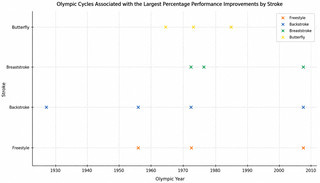
The study found that final times in Olympic swimming have significantly decreased over the past 100 years, with the most notable improvements seen in freestyle and long-distance events. Specific Olympic cycles, particularly 1956, 1972, and 2008, were associated with the largest performance gains, which coincided with advancements in pool engineering, changes in competition regulations, and innovations in training methodologies and swimsuit technology. Notably, swimming speeds have consistently increased across all events, while reaction times have also shown significant improvements during the recorded Olympic Games.
The findings indicate that Olympic swimming has undergone substantial long-term enhancements in performance, providing a detailed historical overview of how various strokes, distances, and athlete demographics have evolved. The periods of greatest performance improvement align closely with major technological and regulatory developments within the sport, showcasing the interplay between innovation and athletic achievement.
Analyzing Performance Data Trends
The data for this study were meticulously gathered from publicly accessible competitive results on the official World Aquatics website, ensuring a comprehensive representation of elite swimming performance. The analysis revealed that swimmers' final times in events like the 50m freestyle have decreased significantly, with women’s times dropping from 25.76 seconds in 1988 to 24.19 seconds in 2024, marking a 6.1% improvement. Similarly, men's times improved from 22.74 seconds to 21.52 seconds, a 5.4% difference.
Community Events
In the 100m freestyle, women’s final times decreased from 75.12 seconds in 1924 to 52.57 seconds in 2024, a remarkable 30% reduction, while men's times dropped from 61.44 seconds to 47.54 seconds, showing a 22.6% improvement. The study also highlighted significant reductions in 200m and 400m freestyle events, emphasizing the ongoing evolution of competitive swimming.
The comprehensive nature of this study fills a gap in existing literature by systematically evaluating long-term changes in Olympic swimming performance across all strokes and distances. The insights gained from this analysis are expected to serve as valuable benchmarks for coaches, athletes, and sports scientists as they prepare for future competitions at national and international levels. By understanding these historical trends, stakeholders in the swimming community can better strategize and enhance training methodologies to continue pushing the boundaries of performance.